

Mission 01 · Developer tools
OrbitOrca: Deploy and charge for AI-built apps
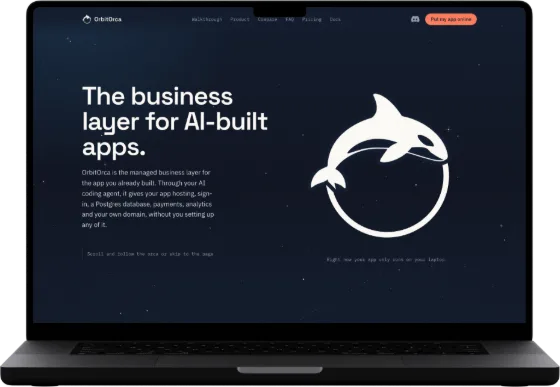
A platform for people who build apps with AI coding agents: it checks an app, puts it online and adds sign-in, a database, payments and analytics. We designed and built it with a business partner from Canada, and the first release came seven weeks after the first commit.
- Partner
- A founder from Canada
- Industry
- Developer tools
- Platforms
- Web and an MCP server
- Built with
- TypeScript, NestJS, Next.js
01 · Business context
The problem
AI coding agents let people build working apps, often without a technical background, but getting such an app to real users is still hard.
It needs a server, a database, sign-up and login, payments, a domain and someone to keep it all running.
Our partner knew this first-hand: they had built several tools with AI on their own computer, and people wanted to pay for one of them, but they did not know how to put it online. The goal was a platform that turns the code people already have into a product others can use and pay for, without the owner setting up servers or writing payment code.
The partner
An entrepreneur from Canada
OrbitOrca is a partnership. The partner brought the idea and leads the business side: marketing, ads and sales.
Geeknauts is the technology partner. We ran the discovery workshops, designed the platform, built it, set up the servers it runs on, and keep developing it with the partner.
02 · Key features
What we built
A dashboard for app owners, an admin panel, a pipeline that runs every app in its own isolated container with its own Postgres database, a public MCP server for coding agents, and the website with the docs. Two developers wrote the code, with an infrastructure engineer, a product owner and a project lead. These are its most important features.
-
From a repository to a live address
Users connect a GitHub repository or upload a ZIP, and the platform builds the app and gives it a database and an https address. A new version gets traffic only once it answers, so a failed release never takes the running app down.
-
A readiness scan with fix prompts
Before a build, the platform checks the code for what would break in production, such as a password left in the code, and each problem comes with a fix prompt for the user's coding agent.
-
An MCP server for coding agents
Claude Code, Cursor, Codex, ChatGPT, Claude.ai and other tools can create, deploy and fix apps for the user. No agent can read a secret value or delete an app.
-
Sign-in, payments and analytics as switches
App owners turn features on for each app, and the platform gives their coding agent a prompt that wires them into the code. The app never holds Stripe keys: it asks the platform whether a customer has paid.

03 · Results
What changed
The first production release came seven weeks after the first commit, and the platform has been in public beta since 1 September 2026.
Key achievements
- First production release in seven weeks, from the first commit on 23 June to 10 August 2026.
- A working first version, deploying apps from GitHub with sign-in and Stripe payments, shown to the partner after about three weeks.
- In public beta since 1 September 2026, with guides for connecting ten coding tools and chat apps.
- After the first weeks of real use, the seven-step setup became a one-page flow: import, scan, deploy.
More missions
Browse the portfolio
Next mission: yours.
Bring an idea, a half-built app or a live product. Start with the mission brief: it takes two minutes, and our team replies within 8 working hours.